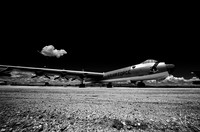
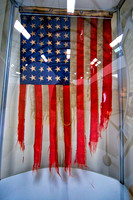
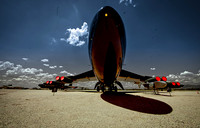
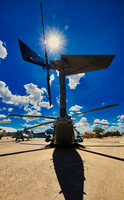
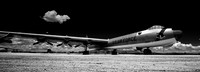
PIMA AIR AND SPACE MUSEUM TUCSON, ARIZONA PREFACE: I had the opportunity to shoot at this amazing place in the hot sun with my
CANON EOS R EF 70-200 f2.8 III & EF 11/24 f4 to capture some amazing shots.
Of course, I'll be posting more pictures over the next several months.
Enjoy.
s.
HISTORY OF THE PIMA AIR AND SPACE MUSEUM by James Stemm, Director of Collections/Restoration CONCEPT The concept for the Pima Air & Space Museum began in 1966 during the celebration of the 25th Anniversary of the creation of the United States Air Force. Earlier the commanders of Davis-Monthan Air Force Base and the Military Aircraft Storage and Disposition Center (MASDC) the forerunner to today’s 309th Aircraft Maintenance and Regeneration Group (309 AMARG) recognized that the historic World War II and 1950s era aircraft stored on the base were rapidly disappearing into smelters and that the flames were consuming not just metal, but the aviation heritage of the country.
On their own initiative, base officials began to set aside examples of the many types of aircraft stored in MASDC’s yards. These planes were placed along the base’s fence line so that the public could see them through the fence.
The display quickly became very popular with the local community but viewing the aircraft through the fence was somewhat unsatisfying.
THE FOUNDATION In 1966, Colonel I. R. Perkin, the commander of MASDC joined with members of the Tucson chapter of the Air Force Association to found the Tucson Air Museum Foundation of Pima County whose goal was to create a publicly accessible museum based around the aircraft already collected on the base.
The Foundation received the enthusiastic backing of the Pima County Board of Supervisors and the County Department of Parks and Recreation. With the backing of the County government the search for a site for the museum soon settled on a 320-acre plot of Federal Bureau of Land Management land just south of Davis-Monthan AFB. The Foundation raised the purchase price of $800 and donated the money to the county for the purchase. On September 11, 1968,
United States Representative Morris K. Udall presented the land to Pima County on behalf of the BLM. Before the aircraft set aside for the museum could be moved to the new site the area had to be prepared to meet the requirements of the United States Air Force Museum. The county authorized the fencing and lighting of approximately 30 acres of the new park for the initial museum site. For the next several years the Foundation set about raising the money needed to make the site ready.
1ST MAJOR ACQUISITION - THE B-24 It was during 1969, that the Foundation made its first major acquisition from outside of Tucson. That year the government of the Republic of India retired the last operational Consolidated B-24 Liberators in the world. One of the Foundation’s leaders, Lt. Colonel Rhodes Arnold wrote to the Chief of the Indian Air Staff in New Delhi, asking that one of the rare bombers be donated to the museum. Much to everyone’s surprise the Indian government agreed, as long as the Foundation paid all the costs of delivery.
On March 22, 1969 after several months of gathering sponsors and fund raising, a volunteer U.S. Air Force crew arrived in India to pick up the Liberator. After stops in the Middle East, Europe, Canada, and back at the factory in Fort Worth, Texas where it had been built, the B-24 arrived in Tucson on April 27, 1969, thirty-one days and 11,000 miles after leaving India. Dignitaries from the U.S. Air Force, the Indian government and Pima County, led by aviation pioneer General Jimmy Doolittle were on hand to greet the plane and congratulate the crew on their achievement.
THE COLLECTION GROWS Meanwhile, preparations for the move to the new museum site continued, but it was not until 1973 that the museum was ready for inspection and certification by the Air Force Museum. The first thirty-five aircraft began moving to the new museum from MASDC in August 1973.
Around this time the Foundation acquired the last of the World War II barracks buildings at Davis-Monthan and transported it to the museum to house small displays. Over the next two years more planes joined the collection and by 1975 approximately 50 aircraft, helicopters, and missiles had been gathered.
It was decided to open the museum in 1976 as a part of the celebration of the United States Bicentennial, and on May 8, 1976 the museum’s gates opened to the public.
OUR HISTORY - PART 2 PIMA AIR & SPACE MUSEUM Creating unlimited horizons in aerospace education through the preservation and presentation of the history of flight.
SIMPLE BEGINNINGS In the beginning the museum was little more than a fenced in field with airplanes parked on it and a small, white, trailer to serve as ticket booth and administrative office.
By early the next year further small improvements to the museum’s infrastructure were put in place. The museum acquired several surplus storage buildings and erected a small, open-sided shelter for aircraft undergoing restoration in 1978.
The dedicated staff and volunteers made the best of the primitive conditions and slowly the museum’s aircraft began to be reassembled, repaired, and repainted. In the early years, the museum could be easily mistaken for a part of MASDC, or one of the numerous scrap yards in the area.
HANGAR 1 Nevertheless, attendance was good and over the next four years over a quarter of a million visitors came through the gates. In 1980, the museum began planning for the first large permanent display building. The building would house a gift shop and admissions area, and a display gallery for the collection of fabric covered aircraft. Construction of “Hangar One” began in 1981 and was completed early the next year.
The new building greatly enhanced the visitor experience at the museum and annual attendance numbers continued to climb.
390TH MEMORIAL MUSEUM In 1982, the museum entered into partnership with the 390th Bomb Group Memorial Museum Foundation to create a museum dedicated to the World War II history of the 390th and the B-17.
The 390th Memorial Museum opened in 1984 in its own building in the center of the museum grounds. Run as a separate museum by veterans of the 390th the building houses a B-17G Flying Fortress along with a library and an extensive collection of artifacts from the members of the 390th Bomb Group.
TITAN TOO! That same year then President Reagan announced that the Titan II ICBM system would be retired. Of the three Wings of missiles scattered around the United States the first selected for deactivation was the 390th Strategic Missile Wing located at Davis-Monthan Air Force Base in Tucson.
The Tucson community again stepped forward with the idea of preserving a part of aviation history by turning one of the soon to be deactivated silos into a museum. The Tucson Air Museum Foundation agreed and the Air Force was approached with the idea. After much negotiation, both within the U.S. government and with the Soviet Union it was agreed that one silo would be preserved for use as a museum.
The one selected was located near Green Valley, Arizona. The silo was deactivated on November 11, 1982 and after Soviet satellites were given time to verify that both the silo and the missile that would go in it had been rendered harmless, work began to set up a visitor center at the formerly highly guarded site. The Titan Missile Museum opened to the public in May 1986, ten years to the day after the opening of the Pima Air Museum, offering a rare look, both above and below ground, at the top-secret world of a nuclear missile silo.
HANGAR 2 While the Pima Air Museum’s visitors enjoyed the benefits of new display buildings the staff continued to labor in rather primitive quarters. Much of the museum’s collection was stored inside the larger aircraft or on the top floor of the barracks building. In 1987 this finally changed with the construction of Hangar Two.
This building was designed to house the museum’s administrative offices, library, archives, collections storage and a small exhibit gallery for the Arizona Aviation Hall of Fame.
PIMA AIR & SPACE MUSEUM Creating unlimited horizons in aerospace education through the preservation and presentation of the history of flight. Charity EIN: 86-6031135
CONTACT INFO
520-574-0462
6000 E. Valencia Road Tucson, AZ 85756
Open 9:00 AM – 3:00 PM Daily
Last Admittance at 1:30pm